



Table of contents

As we speak, there is a quiet storm brewing in agency economics’ proverbial hornet’s nest.
Not just incremental, but instead a foundational change.
Agencies are moving from “build everything in-house” to “own the client, externalize execution.”
And this shift isn’t speculative, it’s backed by data:
- 70% of companies cite cost reduction as a primary driver for outsourcing (Deloitte).
- 59% of businesses outsource to reduce costs, while 57% do so to focus on core functions.
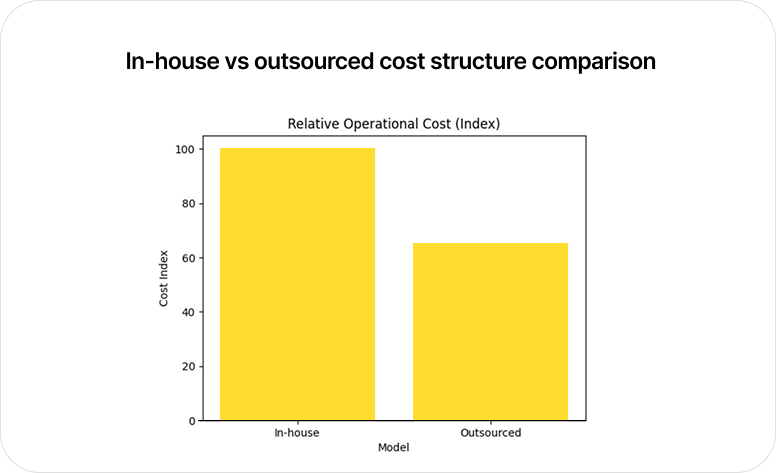
- Companies typically achieve 25–40% cost savings through outsourcing, with many reporting 30%+ within the first year.

That’s not incremental improvement; it’s a completely different growth curve.
When agencies think they need more people, they might actually need a different delivery architecture.
That’s where white-label digital marketing for agencies becomes relevant, not as a backup plan, but as a deliberate operating model.
On that note, let’s get to work!
Understanding the fundamentals of white-label digital marketing (stripped to its operational core)
Let’s set aside definitions for a moment and focus on gaining conceptual clarity.
So, white-label only makes sense when you understand what problem it solves.
And the problem it solves is this, agencies are excellent at acquiring and managing clients, but inefficient at scaling execution internally.
Simply put, instead of forcing internal scale, white label does something smarter.
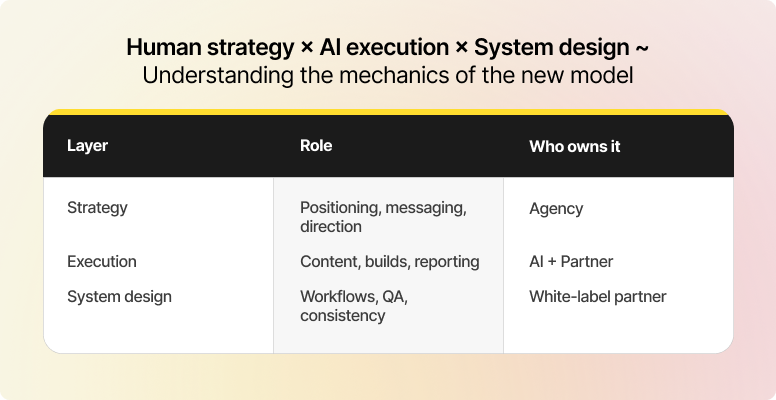
You own demand (sales, positioning, relationships); a partner owns execution at scale; and the client sees a single, unified brand that is undeniably yours.
Well, that’s the functional reality of white-label digital marketing, but here’s where most explanations fall short: white-label is not about “delegation.” It’s about the separation of concerns:
Strategy stays with you, and execution becomes modular.
When done correctly, this doesn’t weaken your agency.
It makes it more focused.
Taking a deeper dive into the white-label business model (beyond “buy low, sell high”)
So yes, the white-label business model involves margin.
But if that’s all you optimize for, you’ll plateau early.
The real model has three moving parts, and all three need to work together.
1. Demand ownership (where agencies actually create value)
You get to keep tabs on positioning, messaging, sales process, and client experience. And this is non-transferable.
If you were to lose control here, my friend, you ain’t running an agency, you are just reselling!
2. Delivery abstraction (how scale actually happens)
Execution now becomes process-driven, repeatable, and independent of individual hires.
This is the core advantage: instead of “We need to hire before we sell,” you move to “We can sell because delivery already exists.”
3. Margin architecture (where most agencies get it wrong)
It's important to know that margins don’t come from arbitrary markups.
Instead, they come from:
- Reduced operational drag
- Faster turnaround times
- Lower rework cycles
Two agencies can use the same provider and get wildly different results simply because one treats white-label as a cost, while the other treats it as infrastructure.
White label vs reseller vs subcontracting (the distinction that only becomes obvious when things start breaking)
Now, at a small scale, these three models feel almost identical.
You’re getting work done outside your core team, clients are paying, deliverables are going out, and everything “works.”
But scale doesn’t just increase volume; it tends to amplify friction.
And that’s when the differences between these models stop being theoretical and start showing up in your margins, client retention, operational stress, and ultimately, your reputation.
We will now deep dive into the intricacies of all three models.
White-label model
In this model, you own the client, the narrative, and part of the system.
On paper, white-labeling sounds simple; you sell under your brand, a partner handles the work, and the client never sees the backend.
But what makes white label powerful isn’t invisibility.
It’s control over perception where you decide how strategy is positioned, how results are communicated, and what success looks like to the client.
And because most white-label partners operate on standardized processes, you also get predictable timelines, structured reporting, and repeatable delivery.
That consistency is what makes this model scale.
But here’s the part people don’t say out loud: you’re not outsourcing responsibility, you’re absorbing it.
If something goes wrong, the client doesn’t blame your partner; they don’t even know your partner exists, so (yes, you guessed it right) they blame you.
So while execution is external, accountability is fully internal.
That’s why white label works best for agencies that understand the services they sell, stay involved in strategy, and actively shape client communication.
This is a scaling model because it lets you grow without tying revenue directly to headcount, as long as you stay in control of the system.
Reseller model
In this particular model, you sell access, however you don’t control the experience.
Reselling is often confused with white-labeling, but the distinction is subtle yet important.
In a reseller model, you’re selling someone else’s product or service; their brand is usually visible (or at least not fully hidden), and they largely control delivery, pricing, and positioning.
You’re not shaping the system, you’re plugging into it.
That can work beautifully in the short term, faster to start, with minimal operational overhead, and no need to manage delivery.
But here’s where it starts to crack under pressure, as you can’t fully control pricing conversations, can’t meaningfully differentiate your offering, and you’re limited in how you handle client expectations.
And over time, something subtle begins to happen where the client’s trust starts attaching to the underlying provider, not you.
Which means you become replaceable, margins get squeezed, and growth plateaus faster than expected.
Reselling isn’t broken, it’s just not designed for deep agency scaling.
This is a distribution model that is great for extending reach, albeit weak for building long-term control.
Subcontracting (outsourcing)
In this model, you manage people, and people are where variability lives.
This is the most familiar model that involves hiring freelancers, working with small external teams, and assigning tasks project by project.
At first, it feels flexible and efficient.
You get direct access to talent, cost control, and adaptability.
But as volume increases, the cracks don’t just appear; instead, they multiply.
Because subcontracting doesn’t give you a system.
It gives you individual contributors.
And with that come inconsistent processes, varying quality standards, communication gaps, and a reliance on specific people.
So instead of scaling cleanly, you end up doing more of this, re-explaining briefs, reviewing work manually, fixing inconsistencies, and managing timelines closely.
In other words, you don’t remove operational load, you redistribute it onto yourself (or your core team).
Subcontracting works well when you’re early-stage, your volume is manageable, or your needs are highly specialized.
But it struggles when you need repeatability, you want a predictable output, or you’re managing multiple clients at once.
This is a resource model, which is flexible, yes, but heavily dependent on management bandwidth.
If you are wondering about the real difference between white-label and outsourcing, here is the one line that most agencies refrain from articulating out loud, and that is while outsourcing gives you people, white-label gives you systems!
So, if your current setup requires constant supervision, manual coordination, and frequent corrections, you’re outsourcing, not running a white-label model.
Why agencies use white label services (the real reasons, not the obvious ones!)
So, yes, you are familiar with the surface-level answers to this question, such as “It saves time” or “It reduces hiring”, but these are not the reasons behind agencies sticking with it; that’s just why they try it.
The real reasons only become apparent after you’ve tried scaling the hard way first.
1. It breaks the link between growth and headcount
In a traditional setup, growth comes with a very predictable tax.
You sign more clients, so you need more people.
Which, in turn, signals the entire process of hiring, onboarding, training, and managing.
And all of that happens before those hires become productive.
So even when revenue goes up, things feel tight.
Because your capacity always lags behind demand.
With white label, that relationship changes.
You don’t think, “We need to hire before we can take this on.”
Instead, the train of thought veers toward, “We can take this on and figure out allocation.”
That’s a very different place to operate from.
You’re not waiting on hiring cycles, notice periods, and ramp-up time.
You’re just moving.
And once you experience that shift, it’s hard to go back.
Here’s a quick mini case study that you might find interesting.
A 6-client performance marketing agency avoided hiring an SEO team and partnered with a white-label provider. And within 6 months they;
- Expanded into SEO + content
- Increased revenue by ~2.3x
- Added zero headcount
2. It lets you avoid decisions you can’t undo easily
Hiring sounds like progress, and sometimes it is.
But it’s also one of the most committing decisions you make as an agency.
Because once you hire, you’re locked into fixed costs, you’re responsible for utilization, and letting people go is rarely clean.
So you hesitate, overthink, and delay.
White label doesn’t carry that weight.
It’s flexible, replaceable, and adjustable.
You can scale up when things are busy and scale back when they’re not.
No awkward internal conversations or the dread of long-term commitments hanging over you.
It gives you room to breathe.
3. It lets you sell before you’re “ready.”
This is probably the most underrated reason.
Most agencies think they need to build capability first.
So they wait and think along the lines of, “Let’s hire an SEO lead”, “Let’s build a content team,” and “Let’s set up processes”.
And in that endeavor, months go by, and nothing launches.
White label flips that.
You can sell the service, get a couple of clients in, and see if there’s real demand.
And then decide, “Is this worth building internally?” because that alone saves you from a lot of bad bets.
Because not every service sells well, fits your client base, or aligns with your positioning, it’s better to find that out early, without building a whole team around it.
4. It shortcuts the learning curve (in a very practical way)
Some parts of digital marketing are easy to pick up, while others are not.
Stuff like SEO (especially technical & link building), high-spend paid media, and conversion optimization aren’t things you “figure out in a few months.”
They take time, mistakes, and iteration.
And during that time, clients are paying you.
This makes on-the-job learning risky.
White label lets you bypass that phase.
You’re plugging into people who’ve already made those mistakes, systems that have been refined over time, and workflows that don’t need to be reinvented.
It doesn’t make you an expert overnight.
But it lets you operate at a level you'd take years to reach on your own.
If you are wondering what this really boils down to, well, none of this is about “saving time” in the way people usually mean it.
It’s about removing friction from growth where you’re not blocked by hiring, not stuck with irreversible decisions, not waiting to be “ready,” and not learning everything from scratch.
You’re just moving faster, with fewer constraints.
And if you’ve ever tried scaling an agency without this kind of flexibility, you know how heavy everything feels without it.
If you are weighing your options and wondering if white-label is the right fit for you, here’s how to decide!
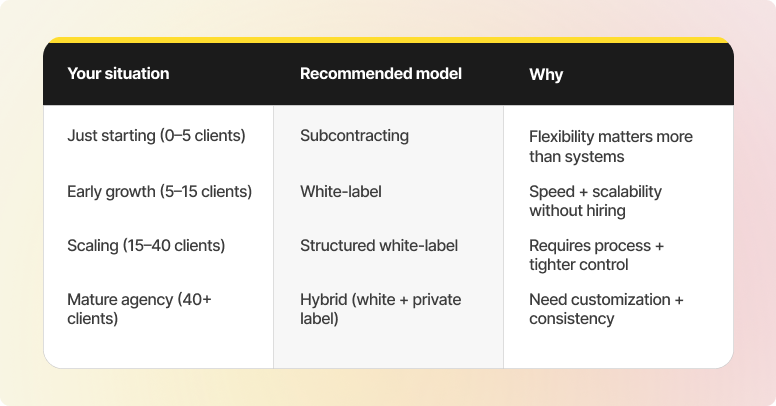
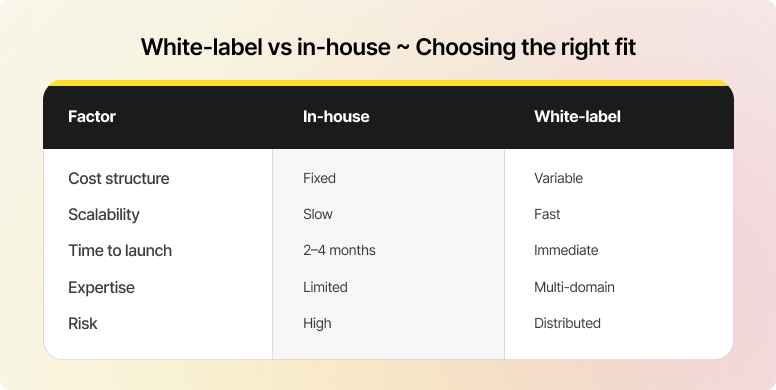
White-label vs in-house (the decision most agencies face)
With our cumulative experience & expertise of more than a decade, we have encountered multiple agencies on the fence about making this decision. Here’s how to choose the right-fit model for your unique needs.
Another important factor that you may want to consider is the costs involved.
Here’s an in-house vs outsourced cost structure comparison, based on industry analyses from Deloitte, Forbes, and multiple outsourcing cost studies.
Decoding the eternal debate between private label vs white-label
So, at first, you probably don’t care about this; you just need the delivery to happen without everything falling apart.
So you go with white label, plug into a system, get work out the door, keep clients moving.
Done.
Then somewhere down the line, usually when you’ve got 20, maybe 30 clients, something changes.
Not dramatically, and honestly, nothing explodes.
But you start noticing that small things are piling up.
You’re tweaking reports more than you used to, re-explaining context to new people on the delivery side, and adjusting client expectations instead of just showing clean progress.
And it’s not that your partner is not the right fit.
It’s that the setup you’re using was never built for this level of nuance.
That’s when this whole “white label vs private label” thing stops being jargon and starts becoming a real operational decision.
White-label (the choice that got you here)
White label is great in the phase where you’re just trying to move fast.
You don’t want to build systems, hire aggressively, or introduce any complexity.
So you plug into something that already works, there’s a team, a process, and a reporting format.
You send inputs, work comes back, and clients are updated.
It’s clean, efficient, and predictable.
And honestly, it’s the reason most agencies even get off the ground properly.
But here’s the part that creeps in later: the system doesn’t really bend.
So when your clients start getting a bit more demanding (which they always do), you find yourself doing weird in-between work, such as “Let me reframe this report before sending it”, “Let me explain this differently so it lands better,” or “Let me just tweak this one thing manually.”
Individually, these are small, but collectively, they start eating your time.
And more importantly, your mental bandwidth.
Private label (what you start wanting without realizing it)
At some point, you stop wanting “a system that works,” instead, you start wanting “something that works the way we work.
”That’s the shift.
With private label (or even semi-private setups), things feel different almost immediately.
You’re not explaining the same things over and over, because the people working on your accounts actually remember the context, and reporting doesn’t need translation before it goes to the client.
There’s less friction.
Not because the work is magically better, but because there’s continuity.
Same people, same understanding, and the same flow, and that alone removes a surprising amount of chaos.
But yeah, it comes at a cost.
This is the part people don’t like talking about.
When you move toward private label, you’re trading speed for alignment, low cost for control, and plug-and-play for involvement.
You’ll probably pay more, spend more time upfront setting things up, and be more involved in how things run.
Because now you’re not just using a system, you’re shaping it.
How white-label services work (the version that actually holds up once you’re juggling real clients)
While “you sell, they deliver” is technically true, it leaves out everything that determines whether this setup feels smooth or slowly starts stressing you out.
Because the work itself is rarely the problem, it’s everything around the work.
It starts before onboarding, when you’re still on the sales call.
And this is where most agencies unknowingly create problems for themselves.
The client says, “We want more traffic”, or “We want better ROAS”, and maybe hits you with “Our SEO isn’t working.”
And instead of tightening that up, you accept it as-is.
You close the deal.
Now that the vague goal becomes something your delivery partner is supposed to execute against.
See the gap?
If you don’t define what kind of traffic, what timeline, what constraints (budget, tech, approvals), then your partner fills in the blanks.
And they’ll usually fill them in with something safe and standardized.
Which is how you end up with work that’s technically correct, but doesn’t feel tailored.
Then comes onboarding (where you either set things up cleanly or create future friction).
This is the part people rush.
They think, “Let’s get access”, “Let’s introduce everyone,” and basically “Let’s kick things off quickly.”
But good onboarding is slower than that and, honestly, a bit uncomfortable, because it forces clarity.
You’re sitting there asking questions like;
“What does success actually look like for this client?”
“What are we not going to prioritize?”
“Where have things failed before?”
And then you translate all of that into something usable.
Not a vague note but a proper brief.
Something where your partner doesn’t have to guess tone, expectations, or level of aggression (especially in SEO or ads).
If they’re guessing, you’ve already lost a bit of control.
Early execution is where you learn how solid your setup really is
The first 2–4 weeks tell you everything, not through results, but through behavior.
Do they ask questions that make you think?
Do they just execute, or do they challenge things that seem off?
Do timelines hold without constant follow-ups?
A good partner doesn’t just “do the work,” instead, they make you slightly uncomfortable in a good way.
They’ll say stuff like “This might not work the way you’re expecting,” or “We should rethink this angle.”
If that never happens, you’re not working with a partner, you’re working with a task machine.
And task machines are fine, until something needs thinking.
Once execution settles, things should feel almost mundane, and this is a good sign.
No chaos, constant checking, and no surprises popping up in client calls.
You know what’s being done, when it’s being done, and what you’ll see next.
That kind of predictability only comes from clear processes, proper documentation, and teams that aren’t reinventing things every week.
If you’re still chasing updates or asking “what’s the status?” regularly, something upstream isn’t tight.
Reporting is where most agencies quietly weaken their own position.
This one’s subtle, but important.
If you take a report from your partner and just pass it on, you’re basically telling the client, “The real work is happening somewhere else.”
Even if that’s not what you mean.
Also, clients don’t need more data; instead, they need clarity, direction, and reassurance that things are moving toward something intentional.
So instead of forwarding reports, you’re doing a bit of translation work by saying things like “Here’s what actually changed this month”, “Here’s why it changed”, or “Here’s what we’re doing next because of it.”
It’s not about sounding smart; it’s about removing confusion.
That’s what clients value more than raw output.
The real make-or-break: what happens when things don’t go as planned
Because honestly, at some point, they won’t.
Performance might dip, timelines may stretch, and something doesn’t land the way you expected.
This is where weak setups start to show the chinks in their armor.
In weaker setups, issues get noticed late, feedback is vague (“let’s improve performance”), fixes take longer than they should, and everything feels slightly delayed.
In stronger setups, things feel tighter, someone flags the issue early, there’s a clear conversation around why it happened, and next steps are defined quickly.
No drama, just good ‘ol adjustment.
And that’s what keeps clients from losing confidence, because clients don’t expect perfection; they expect responsiveness.
Here’s what this really looks like when it’s working well.
It doesn’t feel like “we outsourced this”; instead, it feels like “this is just how our agency delivers.”
You’re not constantly thinking about the partner; you’re thinking about the client, the outcomes, and the next move.
And the delivery layer just runs.
And when it’s not working, it won’t collapse dramatically.
It’ll feel like you’re double-checking more than you should, or you’re rephrasing things before sending them, or maybe you’re slightly uneasy before client calls.
Nothing is clearly broken, but nothing feels fully solid either.
And that’s usually a sign that one of these layers, input, alignment, execution, or communication, isn’t tight enough.
If you had to boil it down, white-label works when:
- you’re clear before the work starts
- you stay involved without micromanaging
- and communication stays honest on both sides
On the contrary, it stops working when:
- things get vague
- assumptions go unchecked
- and small issues don’t get addressed early
So, if your delivery feels harder than it should, it’s rarely about effort; instead, it’s about structure.
We recommend that you take a step back and audit your last 2–3 client projects:
- Where did things feel unclear?
- Where did you step in more than expected?
- Where did communication break down?
Those friction points aren’t random; they’re signals.
Here’s another case study that you might want to peruse at this point.
A 22-client agency using freelancers faced inconsistent quality and missed timelines.
After switching to structured white-label, they witnessed the following changes;
- Turnaround improved by ~35%
- Client churn reduced significantly within one quarter
When not to use the white-label model
To keep the narrative honest and unbiased, it is important to highlight the scenarios when white-label might not be the right model for you, as it is not universally optimal.
We recommend that you steer clear from it when;
- You don’t understand the service you're selling
- Your margins cannot absorb partner costs
- You require full control over IP/process
- Your client volume is too low to justify systems
In these cases, subcontracting or in-house may be more suitable.
Understanding the real sentiment ~ What agencies actually say (and what they usually mean in practice)
If you listen closely, across Reddit threads, agency WhatsApp groups, or private Slack channels, the same opinions keep coming up.
They’re not wrong, they’re just incomplete.
“White label is great, until quality drops.”
This usually shows up a few months, not week one.
And when it does, the instinct is to blame the partner.
Sometimes that’s fair, but just as often, it’s a mismatch that was always there.
What tends to get overlooked early is;
- How many layers of review exist before work reaches you
- Whether there’s a consistent process, or just “good people doing their best."
- How the team handles non-standard requests (because clients will go off-script)
In the early phase, with 3–5 clients and predictable deliverables and low complexity, most setups hold up fine.
But once you get to 15–25 clients, across mixed industries and with higher expectations, the same system starts to stretch.
So when agencies say “quality dropped,” what often happens is the system didn’t scale with the volume or expectations evolved, but delivery didn’t.
That’s not unique to white label, by the way. The same thing happens with in-house teams, too, just less visibly.
“Clients don’t care who does the work.”
Now this is mostly true, because clients rarely ask, “Is this outsourced?” and if they do, it’s usually out of curiosity, not concern.
But they do react to unclear answers, delays in communication, and results that don’t match what was discussed.
At that point, they’re not questioning your delivery model.
They’re questioning reliability, ownership, and whether someone’s actually thinking about their business.
So yes, clients don’t care about who executes.
But they care a lot about how clearly things are explained, how consistently things move forward, and how issues are handled when they come up.
If those are solid, a white-label works fine.
If not, the model gets blamed, whether that’s fair or not.
“Margins are amazing.”
Yes, they can be, and that part is real.
Because, compared to hiring, there are no recruitment cycles, no salaries or benefits to be paid, and no long ramp-up time.
So on paper, margins look strong. But there’s another side that doesn’t get talked about as much.
Margins depend heavily on how much extra effort sits on your side.
For example, if you’re reviewing every deliverable in detail, rewriting reports before sending them, and spending more time on client calls explaining things, your actual cost isn’t just what you pay the partner.
It includes your time, your team’s involvement, and the operational overhead of keeping things aligned.
When overhead is low, margins feel great, but when it creeps up, margins shrink quietly.
So the statement isn’t wrong, it’s just conditional.
Decoding a pattern that shows up over time
In the early stage with (the first few clients), everything feels efficient, turnaround is fast, and clients are happy.
In the mid stage (10–25 clients), more coordination is needed, edge cases increase, and communication becomes all the more important.
However, in the later stage, small inefficiencies compound, quality consistency matters more than speed, and internal processes start mattering as much as partner capability.
This is where opinions about white label start to shift, not because the model changed, but because the context did.
What this really comes down to is that most of the strong opinions, whether positive or negative, come from how the setup was implemented, not the model itself.
White label tends to work well when:
- expectations are clearly defined upfront
- communication is structured, not reactive
- there’s some level of quality control before work reaches the client
But it tends to struggle when:
- briefs are vague
- feedback loops are slow or inconsistent
- too much is assumed instead of clarified
The honest middle ground is that white-label isn’t a shortcut, and it’s not inherently risky either.
It’s just a different way of structuring delivery.
It trades hiring complexity for coordination complexity, and if that trade is managed well, it works.
If not, it starts feeling harder than it should, usually in ways that aren’t obvious at first.
If you’ve heard mixed opinions about white-label, that’s actually a good sign; it usually means you’re seeing real experiences, not just polished takes.
How agencies make money with white-label (the real levers that actually move the needle)
Most people assume the model works like this, “You outsource delivery at ₹X and sell at ₹Y, and done!”
That’s part of it.
But if that’s all you’re doing, margins will look okay, not great. And they’ll get squeezed the moment complexity increases.
The agencies that do really well with white-label pull a few levers at the same time.
1. Margin stacking (this is where the real upside sits)
If you’re selling isolated services, you’re limiting yourself.
Because individual services are relatively easy to compare, such as “What’s your SEO price?” or “How much for ad management?”
Clients can benchmark that in minutes.
So instead of selling tasks, smarter agencies package outcomes.
Not SEO, content, or CRO, but something closer to “organic growth system”, “revenue acceleration plan”, or “lead generation engine.”
This involves the same underlying work, the same cost base (more or less).
But the perceived value changes because you’re solving a broader problem.
And here’s the important part, this isn’t just positioning fluff.
When services are bundled, results are easier to attribute (“this system is working”), conversations shift from cost to impact, and clients are less likely to isolate and question individual line items.
That’s where better margins come from, not just markup, but framing.
2. Efficiency gains (the quiet driver of profit)
This one doesn’t look exciting, but it’s probably the most reliable lever.
Profit improves when three things happen consistently;
~ less time spent per client
~ fewer mistakes or rework cycles
~ predictable delivery timelines
White-label can enable this, but only if the setup is tight.
Because the opposite is also true.
If briefs are unclear, feedback loops are messy, or outputs need frequent revisions, then efficiency drops quickly.
And when efficiency drops, margins follow.
The agencies that make this work long-term usually invest in better onboarding docs, standardized briefs, and clear review processes.
It’s not glamorous.
But it’s what turns a 30% margin into a 50%+ margin over time, without changing pricing.
3. Time reallocation (this is where growth actually unlocks)
This is the part people underestimate.
White-label doesn’t just reduce workload.
It changes where your time goes.
Without it, a lot of senior bandwidth gets pulled into delivery oversight, troubleshooting, and execution details.
With a stable white-label setup, that same bandwidth can shift toward closing new deals, improving positioning, building higher-value offers, and strengthening client relationships.
And that’s where growth compounds.
Because most agencies don’t struggle with doing the work.
They struggle to build a consistent pipeline, move upmarket, and think beyond day-to-day delivery.
White label, when it’s working well, creates space for that.
4. Retainer stability (the underrated advantage)
One-off projects can work with white-label.
But they’re not where the model shines.
The real strength shows up with recurring services such as SEO, paid media, content, and ongoing optimization.
Because that’s where things stabilize.
You start getting predictable monthly revenue, clearer forecasting, and better cash flow planning.
And just as importantly, your delivery system gets better over time, you learn the client, processes become smoother, and fewer surprises pop up.
That consistency improves both client retention and internal efficiency, which directly benefits profitability.
What ties all of this together is that none of these levers work in isolation.
You can’t package aggressively and run inefficient delivery, or have great margins on paper but constantly lose time fixing issues.
The agencies that make strong, sustainable money with white label usually have:
- clear positioning (so they’re not price-competing)
- structured processes (so delivery doesn’t leak time)
- and enough control over communication (so clients feel confident)
So, white-label doesn’t automatically increase profit.
It gives you the opportunity to increase profit.
Whether that actually happens depends on how you package your services, how clean your operations are, and how well you use the time it frees up.
If you get those right, margins feel healthy and scalable, but if you miss them, you’ll still make money, but it’ll feel harder than it should.
How AI is redefining white-label economics (and why most agencies are underestimating the shift)
AI isn’t just improving execution quality or reducing turnaround time, instead it’s quietly collapsing the traditional cost structure that white-label was built on.
And that has second-order effects most agencies haven’t fully internalized yet.
1. The arbitrage advantage is disappearing
Historically, white-label worked on a simple equation, lower-cost execution (often geo-based) equals margin expansion.
AI disrupts this.
When content generation, reporting, keyword clustering, ad copy, and even basic strategy layers are partially automated, the cost delta between in-house, freelancer, white-label partner starts narrowing.
Not because partners are getting expensive, but because execution itself is getting cheaper everywhere.
The implications are that white-label is no longer a cost arbitrage play, it’s becoming a systems and orchestration play.
Agencies that still position it as “cost-efficient delivery” are already behind the curve.
2. Execution is compressing. Thinking is becoming the bottleneck.
Yes, generative AI can automate a significant portion of repetitive knowledge work (McKinsey estimates that generative AI and related technologies could automate activities that consume 60–70% of employees’ time, not entire jobs, but a significant portion of task-level work).
But that’s only half the story.
What actually happens in practice is that output becomes faster, iteration cycles shrink, and volume increases.
This creates a new constraint where decision-making speed doesn’t keep up with execution speed.
So instead of asking, “Can this be delivered?” the real question becomes, “Should this be done, and in what direction?”
This is where most white-label setups start to strain.
Because traditional partners are optimized for throughput and consistency, not judgment, prioritization and strategic pushback.
3. Margin expansion is real, albeit unevenly distributed
On paper, AI should increase margins with lower production cost, faster delivery and higher output per resource.
But in reality, three things happen simultaneously:
- Clients expect more for the same price
- Turnaround time becomes a baseline, not a differentiator
- Low-complexity services get commoditized quickly
So margins don’t expand automatically.
They expand only if you control how value is framed.
Agencies that keep selling “deliverables” see margin pressure, while those that make the shift to “outcomes + systems” capture margin upside.
White-label partners alone won’t solve this.
Your positioning layer determines whether AI becomes margin expansion or margin erosion.
4. The role of the white-label partner is changing (quietly but significantly)
Pre-AI, a good partner was reliable, process-driven, and execution-focused.
Post-AI, that baseline is not enough.
Because when tools can generate reports, content drafts, and campaign structures, execution becomes easier to replicate.
So the bar shifts to, Can your partner think?
Specifically speaking;
Do they challenge weak briefs?
Do they identify strategic gaps?
Do they adapt when inputs are flawed?
If not, they become interchangeable production layers, and interchangeable layers are easy to replace, hard to differentiate and constantly under pricing pressure.
5. The real risk isn’t automation, it’s invisible commoditization
Most agencies think the risk is “AI will replace people.”
That’s not what’s happening in white-label.
The real risk is subtler when your delivery starts to feel the same as everyone else’s.
Because everyone is using similar tools, everyone has access to similar outputs, and everyone can move at similar speeds.
So differentiation shifts away from “What is delivered?” to how clearly problems are defined, how intentionally work is prioritized, and how confidently decisions are made.
6. The agencies that win will look structurally different
The strongest agencies over the next few years won’t be the ones with the biggest teams or even the best execution, instead they’ll be the ones that;
- treat white-label + AI as infrastructure
- build strong input systems (briefs, strategy, positioning)
- stay deeply involved in direction, not tasks
In other words, they won’t try to “control execution”; instead, they’ll control what execution is aimed at.
So, this is the model that agencies need to understand now,
Choosing the right white label partner (what actually matters)
Most advice here turns into long checklists, but in reality, a few things matter more than everything else.
1. Do they actually think?
You don’t need someone just to execute instructions.
You need someone who questions assumptions, points out risks, and suggests better ways to approach things.
Not constantly, but when it matters.
If every interaction feels like, “Sure, we’ll do that”, it might feel smooth, but it’s a red flag.
Because real work involves trade-offs, and someone should be calling those out.
2. How do they handle things when they don’t go well?
This is worth asking directly
.Not in a formal way, just plainly, “What do you do when performance drops, or something doesn’t land?”
You’re not looking for a perfect answer.
Instead, you’re listening for whether they acknowledge it happens, how structured their response is, and whether they take ownership or deflect.
Because things will go wrong at some point.
What matters is how they deal with it.
3. Can they handle your next stage and not just your current one?
A lot of providers work well at a small scale with a handful of clients, predictable workflows, and limited variation.
That’s not the test.
The real question is, what happens when you double or triple that?
Do they have processes that hold up, teams that can expand without breaking consistency, and systems that don’t rely on a few key individuals?
You don’t need them to be perfect at scale today.
But you do need to see that they’re built for it.
4. Do they make you better, or just busier?
This is subtle, but important because a good partner doesn’t just take work off your plate; they improve how you think about the work.
You start asking better questions, see patterns earlier, and have sharper client conversations.
If all they’re doing is executing tasks and sending deliverables, you’ll grow in volume, but not in capability.
The best partnerships do both, they give you capacity, and they raise your standard.
The road ahead
If this guide helped you reframe how you think about white-label, the next step is depth.
The difference between “trying” white-label and actually scaling with it lies in the details, how you structure it, where it breaks, and how you refine it over time.
We recommend that you consider exploring the resources below to go deeper into implementation, pitfalls, and real-world execution.
- A Beginner's Guide to White-Label Offshore Digital Marketing
- White Label Marketing: Pros, Cons, and Key Considerations
- When to Hire a White-Label Marketing Partner: A Full Guide
- Avoid White Label Marketing Mistakes: Proven Tips to Master
- How Mavlers Crafts White-Label Service Quotes for Agencies


.png)


